
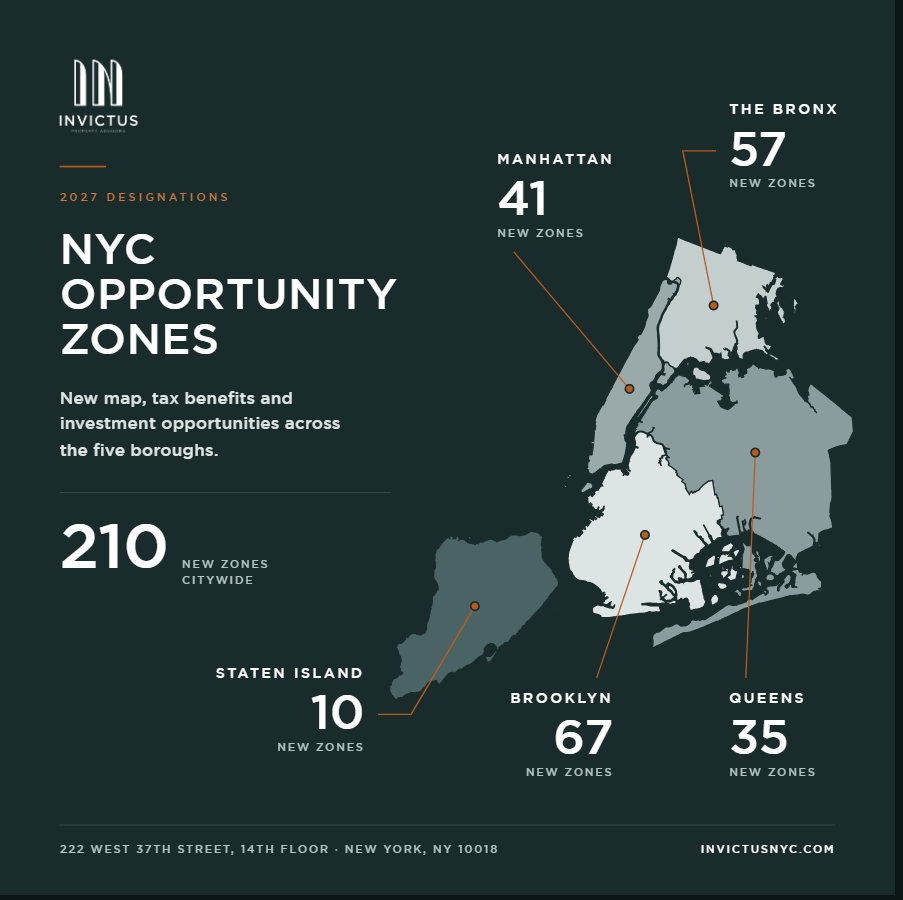
New York City commercial real estate investors have a new set of federal tax incentives to consider beginning in 2027. With 210 census tracts across the five boroughs newly designated as Qualified Opportunity Zones, the updated program could influence investment activity, development financing, and demand for qualifying properties throughout the city.
For property owners and developers, these designations create an opportunity to reassess the investment potential of properties located within the newly established boundaries. With Brooklyn and the Bronx accounting for nearly 60% of New York City's new Opportunity Zones, the changes could be particularly relevant to investors pursuing multifamily, mixed-use, and development opportunities in these markets.
The new designations are part of a nationwide update announced by the U.S. Treasury Department on November 5, 2026, encompassing 6,576 census tracts across the country. The announcement follows the passage of the One Big Beautiful Bill Act in 2025, which made the Opportunity Zone program permanent and introduced additional incentives for long-term investment in economically distressed communities.
How Many Opportunity Zones Are in NYC in 2027?
Under the newly announced designations, New York City will have 210 Qualified Opportunity Zone census tracts beginning January 1, 2027.
The designations are distributed across the five boroughs as follows:
| Borough | New Opportunity Zones |
|---|---|
| Brooklyn | 67 |
| Bronx | 57 |
| Manhattan | 41 |
| Queens | 35 |
| Staten Island | 10 |
| Total NYC | 210 |
Brooklyn and the Bronx account for approximately 59% of the newly designated Opportunity Zones in New York City.
These designations could generate additional interest in development sites, multifamily properties, mixed-use buildings, and other commercial real estate assets located within qualifying census tracts.
However, investors should be aware that the new Opportunity Zone boundaries differ from those established under the original program in 2018. Properties previously located within designated zones may not qualify under the updated 2027 map.
What Is a Qualified Opportunity Zone?
A Qualified Opportunity Zone (QOZ) is a federally designated census tract where qualifying investments may receive preferential federal capital gains tax treatment.
The program was originally established under the Tax Cuts and Jobs Act of 2017 to encourage private investment in economically distressed communities.
Investors generally participate by reinvesting eligible capital gains into a Qualified Opportunity Fund (QOF), an investment vehicle organized to invest in qualifying Opportunity Zone businesses and properties.
For real estate investors, Opportunity Funds can provide a tax-advantaged structure for acquiring, developing, or substantially improving properties within designated census tracts.
Importantly, simply purchasing a property within an Opportunity Zone does not automatically qualify an investor for the program's tax benefits. Investments must satisfy applicable federal requirements, including rules governing Qualified Opportunity Funds and eligible property improvements.
What Are the New Opportunity Zone Tax Benefits in 2027?
The updated Opportunity Zone program introduces several incentives intended to encourage long-term investment.
1. Five-Year Capital Gains Tax Deferral
Beginning in 2027, qualifying investors may defer eligible capital gains invested through Qualified Opportunity Funds for up to five years, subject to applicable requirements and earlier inclusion events.
For example, an investor who sells an investment property in 2027 and realizes a $2 million capital gain may be able to reinvest that gain into a Qualified Opportunity Fund and defer recognition of the gain until 2032.
This can provide investors with additional flexibility when reinvesting proceeds from real estate transactions, business sales, or other appreciated assets.
2. 10% Capital Gains Basis Step-Up
Investors who hold qualifying Opportunity Fund investments for at least five years may receive a basis increase equal to 10% of their originally deferred capital gain.
For example, an investor who reinvests a $2 million capital gain into a qualifying Opportunity Fund and satisfies the five-year holding requirement could receive a $200,000 basis increase.
As a result, the amount of the originally deferred gain subject to federal capital gains taxation could be reduced to $1.8 million.
3. Potential Exclusion of Appreciation After 10 Years
One of the program's most significant long-term incentives is the potential exclusion of qualifying investment appreciation from federal capital gains taxation.
Investors who hold eligible Qualified Opportunity Fund investments for at least 10 years may be able to exclude qualifying appreciation through a basis adjustment upon disposition.
For example, if an investor makes a qualifying $2 million Opportunity Fund investment that appreciates to $4 million over the holding period, the additional $2 million of appreciation could potentially be excluded from federal capital gains taxation.
The benefit is subject to the applicable holding-period, election, and investment requirements.
4. Enhanced Incentives for Rural Opportunity Zones
The updated program also introduces enhanced incentives for qualifying investments in rural Opportunity Zones.
Investors in Qualified Rural Opportunity Funds may be eligible for a 30% basis step-up after satisfying the five-year holding requirement, compared with the standard 10% benefit.
Of New York State's 430 newly designated Opportunity Zones, 124 are classified as rural.
While these enhanced incentives generally will not apply to properties within New York City's five boroughs, they may create additional investment opportunities elsewhere in New York State.
How Does the 2027 Opportunity Zone Program Differ From the Original Program?
The original Opportunity Zone program designated 8,764 census tracts nationwide in 2018.
The updated program reduces that number to 6,576, representing approximately a 25% decrease.
The reduction reflects stricter eligibility requirements, including a revised median family income threshold that generally limits qualifying census tracts to areas with median family incomes at or below 70% of the applicable benchmark, compared with 80% under the original framework.
Other significant changes include:
-
Permanent program: The Opportunity Zone program has been extended on a permanent basis, with periodic redesignations.
-
Rolling capital gains deferral: Qualifying investments beginning in 2027 may benefit from a new five-year deferral period.
-
Five-year basis step-up: Eligible investors may receive a 10% basis increase after five years.
-
Enhanced rural incentives: Qualifying rural investments may receive a 30% basis increase.
-
Updated geographic boundaries: The newly designated census tracts will generally remain in effect through 2036.
The original Opportunity Zone designations generally remain in effect through 2028, making it important for investors to distinguish between the original program and the updated designations when structuring investments.
How Will the New Opportunity Zones Affect NYC Commercial Real Estate?
The new Opportunity Zone designations could influence investment activity across several New York City commercial real estate sectors.
Development Sites
Development sites located within newly designated Opportunity Zones may become more attractive to investors seeking tax-advantaged opportunities.
Developers pursuing ground-up residential, mixed-use, or commercial projects may be able to structure qualifying investments through Opportunity Funds, potentially expanding their access to equity capital.
Multifamily and Mixed-Use Properties
Multifamily and mixed-use properties requiring substantial renovations or repositioning may also attract interest from Opportunity Zone investors.
However, qualifying investments generally must satisfy substantial improvement or other applicable requirements. The acquisition of an existing stabilized building does not necessarily qualify simply because the property is located within an Opportunity Zone.
Value-Add Investment Opportunities
Properties with significant redevelopment potential may be particularly well suited to Opportunity Zone investment strategies.
Investors seeking to reposition underutilized buildings, undertake substantial capital improvements, or pursue adaptive reuse projects may find additional benefits when those properties are located within designated census tracts.
Property Values and Buyer Demand
Opportunity Zone designation can potentially expand the pool of prospective purchasers for qualifying properties.
Investors who have recently realized significant capital gains may be motivated to identify eligible investments, creating additional demand for certain properties.
However, Opportunity Zone designation does not automatically increase property values. Pricing will continue to depend on location, existing income, development potential, financing conditions, and the feasibility of satisfying the program's investment requirements.
Where Can Investors Find the New 2027 NYC Opportunity Zone Map?
The U.S. Treasury Department has released updated Opportunity Zone designation information and mapping resources.
Investors and property owners can review the new boundaries using the official Treasury Department mapping platform.
Official Opportunity Zone Resources:
U.S. Treasury Department:
Opportunity Zone designation information and official resources are available through the Community Development Financial Institutions Fund.
Interactive Opportunity Zone Map:
The Treasury Department's mapping platform allows users to identify designated census tracts and evaluate whether individual properties fall within Opportunity Zone boundaries.
Because the new designations differ from the original 2018 boundaries, investors should verify individual property addresses against the updated 2027 map rather than relying on older Opportunity Zone maps.
It is also important to distinguish between the original designations and the new designations when evaluating investments during the transition period.
What Should NYC Property Owners and Investors Do Now?
With the updated Opportunity Zone designations taking effect January 1, 2027, commercial real estate investors and property owners should begin reviewing how the new boundaries may affect their investment strategies.
Owners of properties located within newly designated census tracts may benefit from evaluating whether Opportunity Zone incentives could expand their prospective buyer pool.
Developers should consider whether qualifying projects could attract additional equity from Opportunity Fund investors.
Investors anticipating significant capital gains from upcoming transactions should consult their tax and legal advisors regarding the timing and structuring requirements associated with Qualified Opportunity Fund investments.
Importantly, Opportunity Zone designation does not change a property's underlying zoning, permitted uses, or development rights, nor does it automatically provide exemptions from New York City property taxes.
The program primarily provides federal capital gains tax incentives for qualifying investments.
Invictus Property Advisors: NYC Opportunity Zone Investment Sales
Invictus Property Advisors is a New York City commercial real estate brokerage specializing in the sale of multifamily properties, mixed-use buildings, development sites, and other investment properties throughout Manhattan, Brooklyn, Queens, and the Bronx.
Our team works with property owners, developers, and investors to evaluate market conditions, identify potential purchasers, and structure competitive sales processes.
With 210 newly designated Opportunity Zones across New York City, the updated program may create additional opportunities for owners of qualifying investment properties and developers pursuing new projects.
Property owners interested in determining whether their building falls within a newly designated Opportunity Zone, or understanding how the designation may influence buyer demand and property valuation, are encouraged to contact our team.
Contact Invictus Property Advisors
222 West 37th Street, 14th Floor
New York, NY 10018
Andrew Levine
(212) 596-7570
Andrew.Levine@invictusnyc.com
Invictus Property Advisors
www.invictusnyc.com
Disclaimer: This article is provided for informational purposes only and does not constitute tax, legal, or investment advice. Opportunity Zone eligibility and tax benefits depend on individual circumstances and compliance with applicable federal requirements. Investors should consult qualified tax and legal professionals before making investment decisions.