
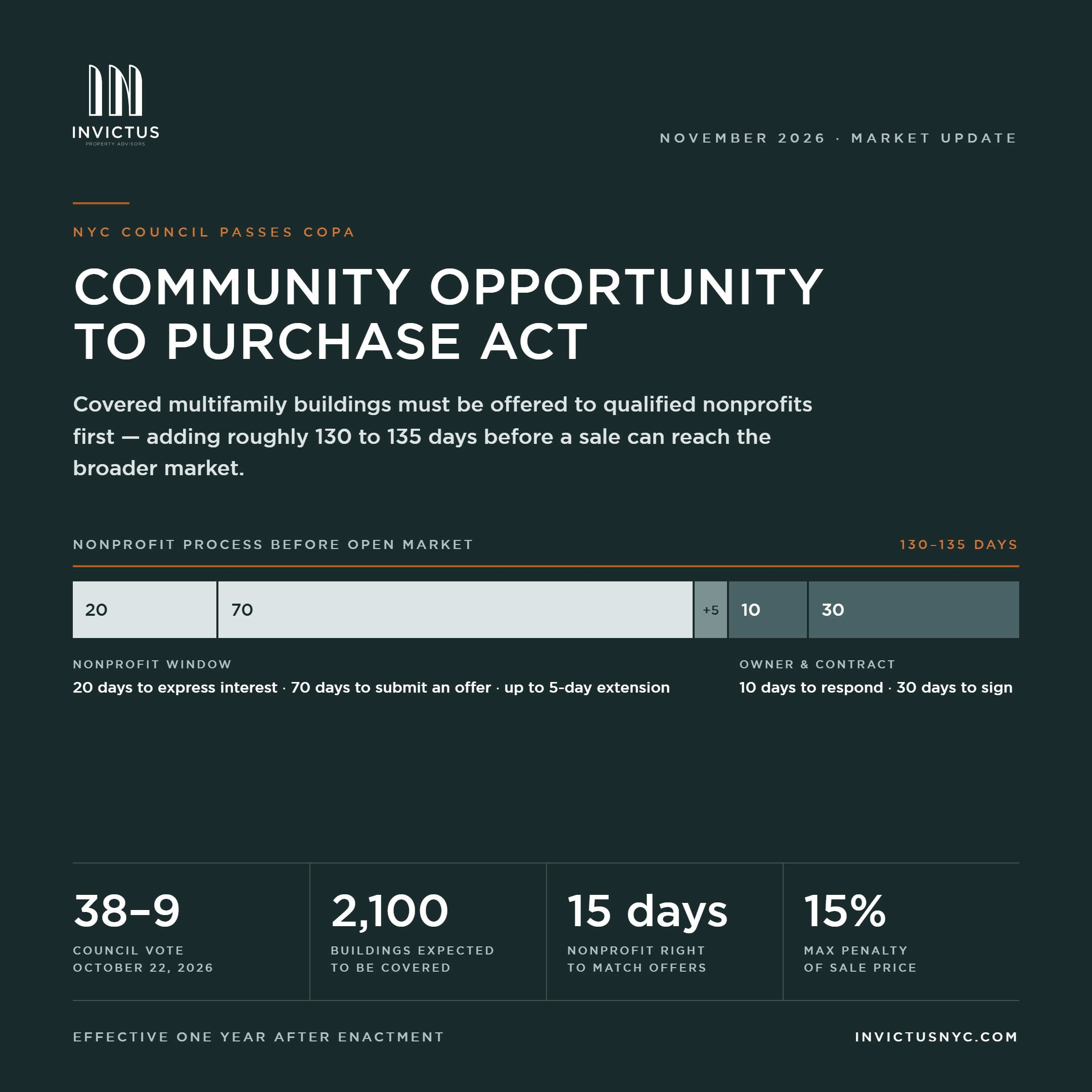
New York City multifamily property owners could soon face additional requirements when selling certain residential buildings. On October 22, 2026, the New York City Council passed a revised version of the Community Opportunity to Purchase Act (COPA), legislation that would give qualified nonprofit organizations the first opportunity to purchase certain multifamily properties before they are offered to the broader market.
The legislation, passed by a 38-to-9 vote, could significantly affect how certain multifamily properties are marketed and sold throughout New York City, particularly buildings with substantial housing violations, properties subject to HPD enforcement programs, and certain affordable housing assets.
For property owners, investors, and real estate brokers, COPA introduces additional considerations surrounding transaction timelines, marketing strategies, and the ability to negotiate with prospective purchasers.
Although the legislation has not yet taken effect, approximately 2,100 buildings across New York City are expected to be covered initially, making it important for owners to understand whether their properties may be subject to the new requirements.
What Is the Community Opportunity to Purchase Act (COPA)?
The Community Opportunity to Purchase Act is proposed New York City legislation intended to provide qualified nonprofit organizations with an opportunity to acquire certain multifamily residential buildings before those properties are sold to private investors.
Under the legislation, owners of covered properties would be required to notify the New York City Department of Housing Preservation and Development (HPD) and certified nonprofit organizations before taking steps to sell their buildings.
Qualifying nonprofits would then receive a designated period to express interest, review property information, and submit purchase offers.
In certain circumstances, nonprofits would also receive a right of first refusal, allowing them to match a third-party purchaser's offer.
The legislation is intended to encourage the preservation of affordable housing and provide nonprofit housing organizations with additional opportunities to acquire properties that may otherwise be sold to private investors.
Which NYC Multifamily Properties Would Be Subject to COPA?
COPA would apply to certain Class A multiple dwellings containing four or more residential units that meet at least one of several qualifying criteria.
Importantly, the legislation does not apply to every multifamily building in New York City.
Properties would generally be covered if they meet one or more of the following conditions:
1. Buildings in HPD's Alternative Enforcement Program (AEP)
Properties that have been enrolled in HPD's Alternative Enforcement Program for at least one year would be subject to COPA.
The AEP program targets residential buildings with significant housing maintenance violations and requires owners to address hazardous conditions.
2. Buildings With Significant HPD Violations
Properties averaging three or more qualifying hazardous or immediately hazardous housing violations per residential unit could be covered.
These generally include Class B and Class C HPD violations.
However, the calculation is more specific than simply dividing a building's current open violations by its apartment count.
Under the revised legislation, qualifying violations must generally have remained open for more than 60 days, with certification deadlines falling within the preceding three years.
HPD would calculate the average number of qualifying open violations over a 12-month period and divide that figure by the number of residential units.
For example, a 20-unit building would generally need an average of at least 60 qualifying open violations over the applicable measurement period to meet this threshold.
3. Buildings Subject to Underlying Conditions Orders
Properties that have been subject to an HPD underlying-conditions order for at least one year would also qualify.
These orders generally address building-wide conditions requiring more extensive repairs than individual apartment violations.
4. Buildings Subject to In Rem Foreclosure
Properties designated as distressed and subject to in rem foreclosure proceedings would be covered.
5. Buildings Denied a Certificate of No Harassment
Properties that have been denied a Certificate of No Harassment within the preceding year, without subsequently curing the conditions that resulted in the denial, would be subject to COPA.
6. Certain Affordable Housing Properties
Buildings containing 100 or fewer residential units that are subject to qualifying HPD affordability restrictions would also be covered.
Under the revised legislation, these restrictions generally must arise from an HPD-managed regulatory agreement.
Are Any Properties Exempt?
Owner-occupied buildings containing five or fewer residential units would be exempt from COPA.
The legislation also contains exclusions for certain transactions, including qualifying family transfers, estate transfers, judicial sales, bankruptcy sales, and certain ownership transfers that do not result in a change of control.
How Would COPA Affect the Sale of a Multifamily Building?
One of the most significant implications of COPA is the additional time that may be required before an owner can market a covered property to traditional investors.
Under the proposed legislation, owners would need to complete a series of notification and offer procedures before proceeding with a conventional sale.
Step 1: Notice of Intent to Sell
Before taking steps to sell a covered property, the owner would be required to notify HPD and all certified qualified nonprofit organizations.
The notice would include identifying information about the property and its ownership, along with certain financial and operating information.
Step 2: Nonprofit Expression of Interest
Certified nonprofit organizations would have 20 days to express interest in purchasing the property.
If a nonprofit expresses interest, the owner would generally have five days to provide additional information, including relevant financial records, mortgage information, housing violations, litigation, and harassment-related information.
Step 3: Nonprofit Offer Period
Interested nonprofits would have 70 days following the initial 20-day expression-of-interest period to submit a purchase offer.
The legislation allows for a limited extension of up to five additional days.
Step 4: Owner Response and Contract Negotiations
Once an offer is submitted, the owner would have 10 days to accept, reject, or counter the offer.
If the parties reach an agreement, they would generally have an additional 30 days to execute a purchase contract.
How Long Could COPA Delay a Property Sale?
Depending on the circumstances, COPA could delay a property's availability to the broader investment market by approximately 130 to 135 days.
For owners seeking to sell quickly, particularly those facing financial distress, mortgage maturities, or significant operating expenses, this additional timeline could become an important consideration.
The precise timing would depend on whether nonprofits express interest, submit offers, and proceed with contract negotiations.
Would Nonprofits Have the Right to Match a Private Investor's Offer?
Yes. In certain circumstances, COPA would provide qualified nonprofit organizations with a right of first refusal.
If an owner rejects a nonprofit's offer and subsequently intends to accept an offer from a third-party purchaser within one year, the owner may be required to notify the nonprofit.
The nonprofit would then have 15 days to match the third-party offer on identical price, terms, and conditions.
For private investors, this could introduce additional uncertainty into the acquisition process.
A purchaser could spend time evaluating a property, conducting due diligence, and negotiating a transaction, only to have a qualified nonprofit exercise its matching rights.
As a result, investors and brokers may need to account for these provisions when structuring offers and establishing transaction timelines.
How Could COPA Affect NYC Multifamily Property Values?
Although COPA does not directly regulate property values or establish maximum sale prices, the legislation could indirectly influence how certain multifamily properties are valued and marketed.
Several factors may become relevant.
Longer Transaction Timelines
The additional notification and offer periods could extend the time required to complete a sale.
For owners with upcoming mortgage maturities, liquidity needs, or other financial obligations, longer marketing timelines may create additional challenges.
Potential Impact on Buyer Demand
Some private investors may be less inclined to pursue properties subject to additional procedural requirements and nonprofit matching rights.
Other investors may continue to pursue these opportunities but factor the additional time and uncertainty into their underwriting.
Distressed Multifamily Properties
The legislation could be particularly relevant to distressed multifamily assets, including buildings with substantial HPD violations, significant deferred maintenance, or enrollment in HPD enforcement programs.
These properties often require experienced investors capable of addressing violations, funding capital improvements, and stabilizing operations.
COPA could introduce additional considerations for both sellers and purchasers involved in these transactions.
Marketing and Pricing Strategies
Property owners considering a sale may benefit from determining their COPA status before bringing a building to market.
Understanding whether a property is covered could help owners establish realistic transaction timelines, evaluate potential purchasers, and develop an appropriate pricing strategy.
How Will HPD Determine Whether a Building Is Covered?
HPD would be responsible for identifying properties subject to COPA and notifying owners of their designation.
Under the proposed framework, HPD would review qualifying building conditions and regulatory criteria to determine coverage.
For properties potentially covered due to housing violations, the calculation would consider qualifying Class B and Class C violations over a designated measurement period.
The legislation contemplates an annual review process, with a June 1 measurement date for the applicable violation calculation.
Owners would also have an opportunity to challenge their property's designation through an administrative hearing.
Because coverage can depend on historical violation records and enforcement status, owners should not assume that a building is exempt simply because its current violation count falls below the applicable threshold.
What Changed in the Revised COPA Legislation?
The version approved by the City Council includes several revisions from earlier proposals.
More Specific Affordable Housing Requirements
Qualifying affordability restrictions must generally arise from HPD-managed regulatory agreements. Recorded restrictive declarations alone would no longer automatically trigger coverage.
Limits on HPD's Authority
The revised legislation removes HPD's ability to expand the categories of covered properties through rulemaking.
Condominium and Cooperative Conversions
Certain condominium and cooperative conversions conducted under Article 23-A of the New York General Business Law would be excluded.
Limits on Extensions
The extension available during the nonprofit offer period would be capped at five days.
Enforcement and Remedies
Owners who fail to comply with COPA could face substantial financial penalties, potentially reaching 15% of the property's sale price.
Qualified nonprofits could also pursue certain legal remedies, including compensatory damages, injunctive relief, and attorneys' fees.
These provisions underscore the importance of determining a property's coverage status before initiating a sale.
When Will COPA Take Effect in NYC?
The New York City Council approved the revised COPA legislation on October 22, 2026, by a vote of 38 to 9.
The legislation is currently awaiting mayoral action.
If enacted, COPA would take effect one year after becoming law, potentially placing implementation in late 2027.
Before the law becomes effective, HPD would need to establish additional rules governing nonprofit certification, notification procedures, and hardship waivers.
One important unresolved issue concerns properties already under contract when the legislation takes effect.
The current bill provides certain exclusions for existing agreements involving qualified entities but does not comprehensively address all pending third-party transactions.
Property owners contemplating sales around the anticipated implementation date should monitor these developments closely.
What Should NYC Multifamily Property Owners Do Now?
Although COPA has not yet taken effect, owners of potentially covered properties should begin evaluating how the legislation may affect their future plans.
Owners considering a sale should review their buildings' HPD violation histories, enforcement status, and applicable affordability restrictions.
Properties with significant housing violations or enrollment in programs such as AEP may warrant particular attention.
For owners anticipating a sale within the next 12 to 24 months, understanding potential COPA coverage could be especially important when evaluating the timing of a transaction.
Investors pursuing distressed multifamily acquisitions should also consider how the legislation may affect due diligence, contract negotiations, and closing timelines.
As HPD develops implementing regulations, additional guidance should provide greater clarity regarding the practical application of the law.
Invictus Property Advisors: NYC Multifamily Investment Sales
Invictus Property Advisors is a New York City commercial real estate brokerage specializing in multifamily, mixed-use, development, and investment property sales throughout Manhattan, Brooklyn, Queens, and the Bronx.
Our team has extensive experience representing owners of rent-stabilized multifamily buildings, distressed assets, and properties with complex regulatory and operational considerations.
With COPA potentially introducing additional requirements for certain multifamily transactions, understanding how the legislation may affect property values, buyer demand, and marketing timelines will become increasingly important.
Property owners considering a sale, particularly those with buildings containing substantial HPD violations or subject to enforcement programs, are encouraged to contact our team to discuss their property's marketability and potential transaction strategy.
Contact Invictus Property Advisors
222 West 37th Street, 14th Floor
New York, NY 10018
Andrew Levine
(212) 596-7570
Andrew.Levine@invictusnyc.com
Invictus Property Advisors
Disclaimer: This article is provided for informational purposes only and does not constitute legal, tax, or investment advice. COPA has not yet taken effect, and its provisions remain subject to enactment, implementing regulations, and applicable legal interpretation. Property owners and investors should consult qualified legal counsel regarding their specific circumstances.