
A Lesser-Known Zoning Change Is Creating New Opportunities for Churches, Nonprofits, and Residential Developers Across NYC
One of the most significant, yet often overlooked, provisions of New York City's City of Yes for Housing Opportunity zoning reforms is the elimination of the Dwelling Unit Factor (DUF) for qualifying conversions of community facility buildings to residential use.
Historically, the Dwelling Unit Factor has limited the number of apartments that can be created within a building based on its residential floor area. Even when a property could physically accommodate additional apartments, zoning regulations often prevented developers from maximizing the number of units.
While City of Yes eliminated the Dwelling Unit Factor for residential developments in Manhattan's core south of 96th Street and Downtown Brooklyn, a lesser-known provision also eliminates the DUF for qualifying conversions of community facility buildings to residential use throughout New York City. This is particularly significant for properties in the outer boroughs and other neighborhoods where the DUF would otherwise continue to restrict the number of permitted apartments.
This change is particularly meaningful for owners of churches, religious institutions, schools, and other community facility properties, especially those with efficient floor plates that can be readily converted into residential apartments.
Why the Dwelling Unit Factor Matters
The Dwelling Unit Factor is a zoning calculation that determines the maximum number of residential units permitted within a building based on the amount of residential floor area.
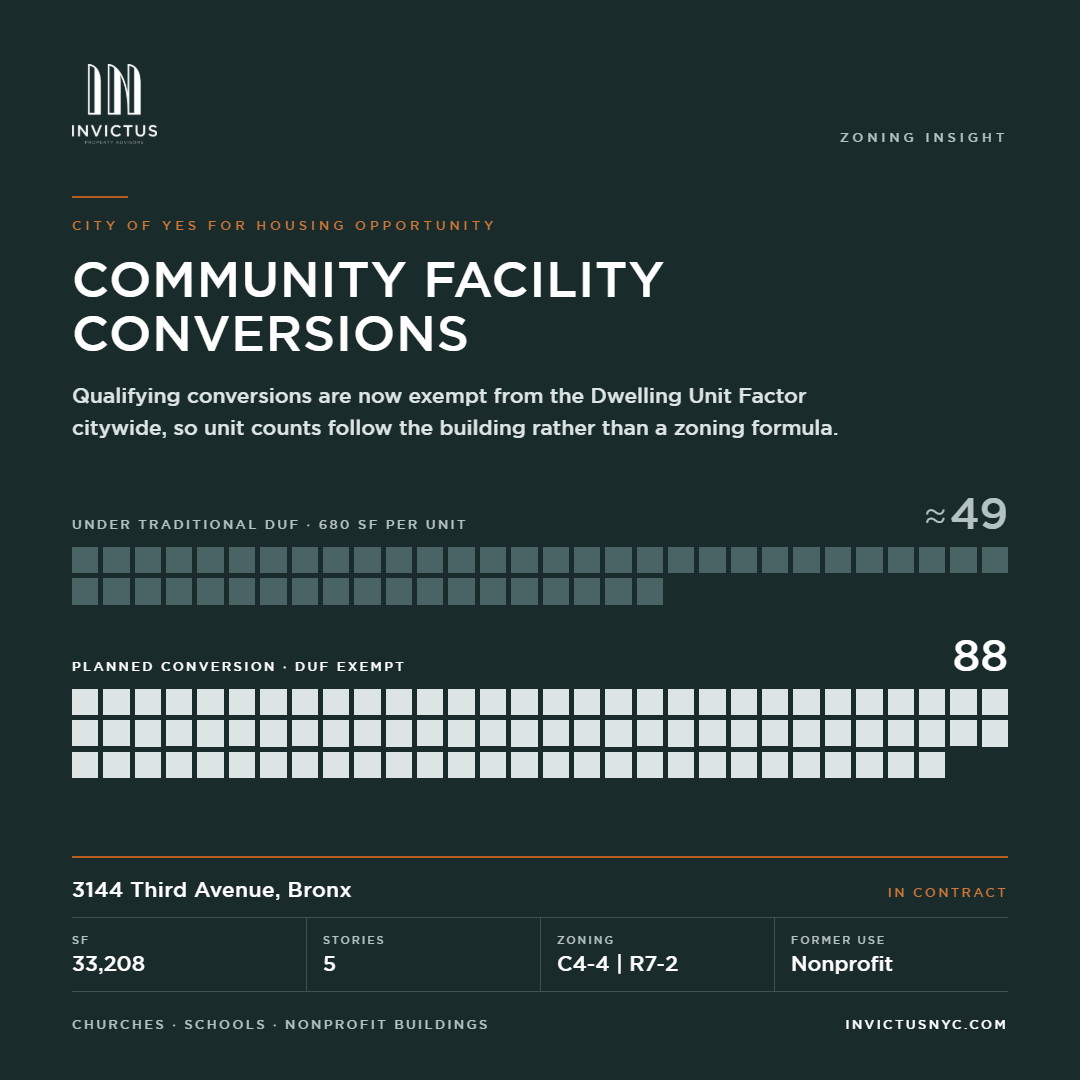
For example, in an R7-2 zoning district, the traditional DUF calculation requires approximately 680 square feet of residential floor area per dwelling unit. Consequently, a building containing 30,000 square feet of residential floor area would ordinarily be limited to approximately 44 apartments.
However, under the revised conversion provisions, qualifying nonresidential buildings can be converted to residential use without being subject to the same DUF restrictions.
Rather than having the number of apartments dictated by a zoning formula, developers have greater flexibility to determine unit counts based on building layouts, applicable building codes, and market demand.
The result is an opportunity to create substantially more apartments within existing buildings without necessarily increasing their overall square footage.
A Recent Example: 3144 Third Avenue, Bronx
Invictus Property Advisors recently placed 3144 Third Avenue in the Bronx under hard contract, providing a compelling example of how these zoning changes are already influencing investment decisions.
Located at the corner of Third Avenue and Brook Avenue, the property is a five-story, approximately 33,208-square-foot building formerly occupied by a nonprofit organization.
The property is situated within a C4-4 zoning district, with an R7-2 residential equivalent, where the traditional Dwelling Unit Factor would ordinarily limit residential density.
The purchaser intends to convert the existing building into 88 residential apartments, taking advantage of the exemption from the Dwelling Unit Factor available to qualifying conversions.
Without this exemption, the number of permitted apartments would be substantially lower.
The ability to create 88 apartments within the existing building significantly changes the economics of the project. Rather than being restricted to larger apartments simply to comply with zoning, the developer can pursue a more efficient unit mix, increase the property's potential rental income, and deliver additional housing without constructing an entirely new building.
This is precisely the type of adaptive reuse that City of Yes was designed to facilitate.
Why Churches and Other Community Facility Owners Should Pay Attention
For brokers representing churches, religious institutions, and nonprofit organizations considering the sale of their real estate, understanding these provisions is particularly important.
Many community facility buildings have characteristics that make them attractive candidates for residential conversion, including generous ceiling heights, large windows, efficient layouts, and substantial existing floor area.
Properties with relatively open floor plates, limited structural obstructions, and conveniently located stairwells and elevators can be especially appealing to developers seeking to minimize conversion costs.
Historically, buyers evaluating these properties may have been constrained by the number of apartments permitted under the Dwelling Unit Factor, even when the existing layout could comfortably accommodate additional units.
Under City of Yes, qualifying properties may now support considerably more apartments than previously permitted.
For property owners, this can translate into a larger pool of prospective purchasers, stronger development economics, and potentially higher property valuations.
For brokers, it reinforces the importance of evaluating not only a building's existing use and square footage, but also its potential residential unit count under the revised zoning regulations.
A church or nonprofit building that might previously have supported 40 or 50 apartments could potentially accommodate significantly more units under a qualifying conversion, depending on its configuration and applicable regulations.
That difference can materially affect what a developer is willing to pay.
Maximizing Existing Buildings While Expanding NYC's Housing Stock
One of my favorite aspects of City of Yes is that it encourages developers to make better use of buildings that already exist.
New York City has a tremendous inventory of older institutional, commercial, and community facility properties that may no longer serve their original purposes but remain structurally sound and well suited for residential use.
By removing unnecessary restrictions on apartment counts, the city is allowing developers to maximize the utility of these buildings while creating additional housing in neighborhoods where new construction may be financially or physically challenging.
For developers, the benefits are straightforward: greater flexibility in unit layouts, the potential for increased rental income, and improved project economics.
For the city, the benefits are equally important: more apartments added to the housing stock, productive reuse of underutilized buildings, and new housing opportunities without requiring additional land or larger building envelopes.
Of course, qualifying conversions remain subject to applicable zoning, building code, light and air, and other regulatory requirements. The elimination of the DUF does not automatically mean every building can accommodate an unlimited number of apartments.
Nevertheless, for properties with efficient layouts and favorable existing conditions, the opportunity can be substantial.
The Takeaway
The elimination of the Dwelling Unit Factor for qualifying community facility conversions represents an important opportunity for property owners and developers throughout New York City, particularly outside Manhattan's core and Downtown Brooklyn.
Our recent transaction at 3144 Third Avenue, where the purchaser plans to convert approximately 33,000 square feet into 88 residential apartments, illustrates the potential impact of this zoning change.
For owners of churches, religious institutions, and other community facility buildings considering a sale, understanding how City of Yes affects residential conversion potential is essential to accurately evaluating a property's highest and best use.
At Invictus Property Advisors, we continue to identify opportunities created by New York City's evolving zoning regulations and help property owners understand how these changes may affect the value of their real estate.